
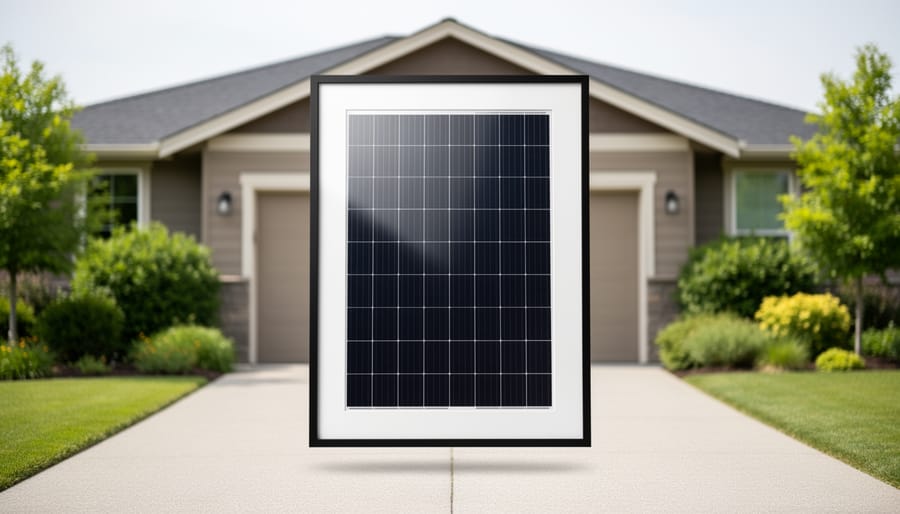
 0
 0
I’ll be upfront: I don’t install solar panels, and I’ve never climbed a ladder holding a racking rail. I spend my time studying how visual software changes buying decisions, mostly in real estate, where virtual staging went from a novelty to standard practice in a few years. While researching this piece I kept running into the same question. If a digitally furnished photo can help someone picture their life in an empty living room, why do so many solar sales still depend on a satellite image, a spreadsheet, and a stranger at the kitchen table saying “trust me”?
This article is my attempt to answer that question with numbers instead of hype. Everything below comes from published research, industry reports, and market data. I’ve linked the sources at the end. Where the evidence is thin, I say so.
The Problem Nobody Puts on the Proposal: People Can’t Picture It
Start with the oldest objection in residential solar, the one that rarely shows up in a CRM field but kills deals anyway: “What’s it going to look like?”
It sounds trivial. It isn’t.
In January 2024, a OnePoll survey of 1,000 UK homeowners, commissioned by , found that 21% would turn down solar panels even if they were free. Read that again. Free. Among those refusers, 35% gave the reason that panels are “ugly.” By my own back-of-envelope math, that’s roughly 7% of all homeowners rejecting a zero-cost asset purely on looks. (One caveat: the reporting on that survey contains an inconsistency about how many would accept, so treat the exact split carefully. The aesthetic objection itself is clearly there.)
The objection isn’t only British. Researchers at MIT studied consumer preferences for residential solar across two US surveys. The finding, as summarized by the panel maker Solaria, is that consumers prefer black panels and will pay more for systems they find more visually appealing, and the effect gets stronger when people are shown renderings of panels on a roof. That last detail matters most for this article. Showing people the result changes how much they care about the result, and how much they’ll pay for it.
So aesthetics is a real variable in the purchase decision. Yet most homeowners decide with very little visual information. They get an overhead satellite tile with blue rectangles on it. That’s useful to an engineer and almost meaningless to someone who sees their house from the driveway, not from 400 miles up.
Real estate figured this out first.
What Real Estate Learned About Visualization (And Why Solar Should Care)
The National Association of REALTORS® publishes a Profile of Home Staging every couple of years. The 2025 edition, based on a February 2025 survey of members, has a number that sits at the center of this whole argument:
83% of buyers’ agents said staging made it easier for buyers to visualize the property as their future home.
That’s not a niche finding. It’s the core reason staging exists. Some other numbers from the same report and press coverage of it:
- Sellers’ agents stage the living room (91%), primary bedroom (83%), and dining room (69%) most often.
- 29% of sellers’ agents reported a 1%–10% increase in the dollar value offered on staged homes (per the Boston Globe’s reporting on the NAR data).
- 49% said staging reduced time on market.
- 8% of agents now use virtual staging only, skipping physical furniture entirely.
That last figure is small but telling. Virtual staging, where software or a designer adds furniture and decor to a photo of an empty room, is cheap. The Boston Globe put it at about $75 per photo with a two-to-three-day turnaround, compared with hundreds or thousands of dollars for physical staging. AI tools have since pushed both cost and turnaround down further, sometimes to minutes.
Here’s the parallel I can’t stop thinking about. A real estate buyer looking at an empty room has an imagination gap. A homeowner looking at a solar proposal has the same gap, about their own roof, which is arguably worse. The buyer is weighing one house among many. The solar customer is being asked to permanently change the face of the house they already own, for 25 years or more, at a price that averaged around $29,000 before incentives in EnergySage’s mid-2025 marketplace data.
Visual tools close imagination gaps. Real estate has the data to prove it. Solar has been slower to apply the lesson.
Why This Matters More in 2026 Than It Did Two Years Ago
If you work in residential solar, you already know 2026 is rough. Here’s the short version for everyone else.
The federal residential clean energy credit (Section 25D) is gone. The One Big Beautiful Bill Act ended the 30% homeowner tax credit for systems installed after December 31, 2025. That removed the strongest closing argument the industry had: “the government pays for almost a third of it.”
The market reaction is showing up in the data:
- The SEIA/Wood Mackenzie Solar Market Insight 2025 Year in Review reported US residential installations fell 2% to 4,647 MW in 2025. The expected last-minute rush before the credit expired “did not manifest,” partly because there simply wasn’t enough time after the law passed.
- Wood Mackenzie expects the residential market to contract about 19% in 2026.
- According to EnergySage’s H2 2025 report, homeowner engagement with installers jumped 205% in the second half of 2025, and most installers had filled their annual capacity by October. That surge pulled demand forward, leaving a thinner pipeline for 2026.
- EnergySage also reported that typical payback periods rose from 7.4 years in Q3 2025 to 10.4 years in Q4, as the credit’s value dropped out of the math for late shoppers.
Now the number I think deserves the most attention. Wood Mackenzie’s March 2026 analysis says residential customer acquisition cost (CAC) hit a five-year low of $0.60 per watt in 2025 and is expected to jump about 40%, to $0.84 per watt, in 2026.
Let’s make that concrete. EnergySage pegged the average system size at 11.8 kW in H2 2025. At $0.84/W, that’s roughly $9,900 in acquisition cost per customer: sales commissions, lead buying, ads, canvassing, and every failed appointment folded in. At a median system price of about $2.49/W, CAC alone eats about a third of the contract value. (That’s my arithmetic from their figures, not a published ratio.)
When acquisition costs climb and the financial pitch gets weaker, two things become more valuable:
- Anything that lifts close rates on leads you’ve already paid for.
- Non-financial reasons to buy: pride, comfort, independence, curb appeal, and the plain satisfaction of seeing your house look the way you want.
Visualization sits at the intersection of both.
So What Does “Virtual Staging for Solar” Actually Mean?
I want to be precise here, because vendors blur these categories constantly.
1. Solar design software (the engineering layer). Platforms like Aurora Solar, OpenSolar, and others use LiDAR, aerial imagery, and shade analysis to build a 3D model of the roof, place modules, and estimate production. Many produce 3D renders. These are design and proposal tools first. The visuals are accurate but often look like a CAD model: tidy, technical, and not much like the photo on your fridge.
2. Virtual staging and AI image-editing software (the emotional layer). These tools started in real estate. They take a real photograph and add, remove, or restyle objects realistically. And they do it fast! The Best Virtual Staging Software takes 10-15 seconds (digitally staged, fully Virtual Home Staging and AI Interior Design app Rendering) only for Staging Potential Solar Panels.
Applied to solar, that means a ground-level photo of the customer’s actual house, taken from the street or the backyard, with photorealistic panels added in the right place, at the right angle, in the right color.
3. Hybrid and AR approaches. Some apps let a homeowner point a phone at the roof and see panels overlaid live. Others combine a design-software layout with a photorealistic edit.
The industry already does layer 1 well. Layer 2 is where real estate’s lesson applies most directly, and it’s the layer most installers I’ve read about either skip or treat as an afterthought.
The difference is perspective. A homeowner judges their house from the curb. They judge it the way their neighbors, their HOA, and a future buyer will see it. A street-level, photorealistic image answers the question “what will it look like?” in the same terms the customer uses to ask it.
Five Ways Visualization Can Change the Solar Sale
These aren’t guesses about magic conversion lifts. I won’t invent a percentage for you, and I’d be suspicious of any vendor who quotes one without showing a methodology. These are the mechanisms, each tied to evidence about how people decide.
1. It neutralizes the “ugly” objection before it’s spoken
The UK data and the MIT research point the same way: some share of buyers care a lot about appearance, and they often won’t say so directly. Nobody wants to tell a salesperson “I’m worried this will look cheap.” They say “let me think about it.”
A rendering showing all-black modules, flush-mounted, with a clean array and no awkward orphan panels on the front-facing roof plane changes the conversation. Instead of defending the aesthetics in words, you let the image do it.
It also opens a useful design conversation. Would they trade 1 kW of capacity to keep the front of the house clear? Do they want black frames or silver? Should the array sit on the garage instead? Those become decisions the customer makes, which leads to point two.
2. It turns the customer into a co-designer
There’s a well-documented effect in behavioral economics called the IKEA effect: people value things more when they’ve helped create them. The original research by Norton, Mochon, and Ariely found people were willing to pay noticeably more for products they had assembled themselves.
When a homeowner chooses between two or three rendered layouts of their own house, they’re no longer being sold a system. They’re picking one. That shift from “pitch” to “choice” is exactly what a high-ticket, long-consideration purchase needs.
3. It survives the kitchen-table-to-spouse handoff
Here’s a scenario anyone in sales will recognize. The rep meets one homeowner. That person likes the deal, then has to explain it to a partner who wasn’t there. The spreadsheet doesn’t travel well. “Twelve panels on the south roof” means nothing to someone who didn’t see the site survey.
A photoreal image does travel well. It can be texted, shown at dinner, and forwarded to a parent who “knows about these things.” In real estate, roughly 51% of buyers find their home online (NAR), and Zillow says about 79% of prospective buyers use a real estate app. Decisions about homes are made with images on screens, often among people who never meet the salesperson. Solar decisions are no different.
4. It answers the resale question visually
The financial case for solar used to lean heavily on the tax credit. Now it leans more on long-term savings and home value. Zillow’s research found homes with solar sold for 4.1% more on average than comparable homes without it, about $9,274 for a median-valued home at the time, with premiums as high as 5.4% in the New York metro.
Two caveats I’d insist on. First, that Zillow data covers sales from March 2018 to February 2019, so it’s dated. Second, a premium depends on ownership. Leased systems can complicate a sale. Still, Zillow also reported that more than 80% of buyers say energy-efficient features are important.
Here’s the subtle point. The resale premium only shows up if a future buyer likes how the house looks with the panels. When a homeowner worries “will this hurt my resale?”, they’re partly worried that panels will look bad in a listing photo. A street-level render answers that worry better than any appraisal study.
And that’s a full-circle moment: the same type of software that stages the eventual listing photo can preview the solar install years earlier.
5. It makes digital marketing look like the customer’s own street
Most solar ads use the same stock photo of a smiling family in front of a beige suburban house with a perfect array. It’s interchangeable, and people scroll past it.
Visualization tools let installers produce before-and-after images of real local housing styles: the brick colonials in one suburb, the Spanish tile roofs in another, the steep Victorian roof lines in an older neighborhood. A “this is what solar looks like on a house like yours” ad hits differently from generic stock. With CAC near $0.84/W, any creative that improves click-through or cost per lead goes straight to margin.
Where It Can Go Wrong: Honesty, Accuracy, and the Law
This is where I want to slow down, because visualization can easily become manipulation.
The render must match the engineering
A beautiful image of 20 panels on a roof that can only fit 16 is not marketing. It’s a future complaint, a chargeback, or a lawsuit. Any visual should come from the actual design: the same module count, the same layout, setbacks for fire code, and real obstructions like vents, chimneys, and skylights. If the photoreal image and the engineering plan disagree, the plan wins and the image gets redone.
Fire code setbacks deserve their own mention. Many jurisdictions follow International Fire Code-based rules requiring clear pathways on roofs for firefighters, often around ridges and edges. An AI tool that fills the whole roof plane will happily ignore those rules. The customer will then be confused when the real install looks sparser than the picture they fell in love with.
Label it as a visualization
Real estate regulation is moving toward disclosure of digitally altered images. The Boston Globe noted that Massachusetts rules bar brokers from advertising “in any way that is false or misleading,” and that most laws “do not specifically address virtual staging or the use of AI.” California went further: AB 723, effective in 2026, requires real estate listings to disclose digitally altered images and give access to the originals.
Solar sales aren’t governed by those real estate rules, but the principle carries over, and consumer protection regulators already watch solar sales practices closely. My recommendation is simple: put “Visualization, final installation may vary” on every rendered image, and keep the unedited original attached in the proposal.
Don’t hide the hardware
It’s tempting to edit out conduit runs, the inverter on the side wall, the battery in the garage, or the extra meter. Don’t. Those are often what homeowners complain about after install, because nobody showed them. An honest render includes the conduit path. Here, accuracy is a sales advantage: the customer trusts the beautiful part because you also showed the boring part.
Watch for “AI glow”
AI image models tend to produce suspiciously perfect skies, saturated lawns, and too-clean shingles. If the render makes the house look nicer than it is, the customer’s brain notices, even if only subconsciously. The 2025 NAR report found 58% of agents said buyers were disappointed when homes didn’t match a TV-staged standard, and 48% said buyers expect homes to look TV-ready. Overpromising visually creates the same letdown. The goal is “your house, with panels,” not “a magazine house that looks a bit like yours.”
What a Good Visualization Workflow Looks Like
Based on how real estate staging works and how solar design tools already operate, here’s a practical workflow I’d suggest to any installer testing this. Treat it as a starting framework, not a field-tested SOP.
Step 1: Capture real photos at the first touchpoint. Front elevation from the street, plus the main roof planes if they’re visible from the yard. Shoot in even light. A midday overcast sky is ideal because it avoids hard shadows. A phone camera is enough.
Step 2: Build the real design first. Use your normal design software for layout, shade analysis, setbacks, and production estimates. That becomes the source of truth.
Step 3: Generate the photoreal version from the design. Use virtual staging or AI editing software (or an outsourced service) to place panels in the photo exactly as the design specifies. Match module color, frame color, and orientation.
Step 4: Make two or three options. For example: maximum production, front roof clear, all black. Show the trade-offs: “Option B looks cleaner from the street and produces about 9% less.” Let the customer choose.
Step 5: Put the image first in the proposal. Lead with the picture, then the numbers. People decide emotionally and justify rationally. Your proposal order should reflect that.
Step 6: Send it in a shareable format. A single JPG they can text to a spouse beats a 14-page PDF behind a login.
Step 7: Close the loop after install. Take the same photo from the same spot once the system is up. Comparing the render with reality keeps you honest, and the matched pairs become your best marketing material, with the customer’s permission.
Cost: Is It Worth It?
Let’s run rough numbers, being clear about what’s estimated.
Real estate virtual staging runs about $75 per photo through human-edited services (Boston Globe, 2026). AI self-serve tools are often cheaper, sometimes a few dollars per image on a subscription. Say an installer spends $50–$150 per prospect to produce two or three solid renders, including staff time.
Compare that with roughly $9,900 in average CAC per customer (my calculation from Wood Mackenzie’s $0.84/W and an 11.8 kW average system). If visualization lifted close rates on qualified appointments even modestly, it would pay for itself many times over. I’m deliberately not inventing that lift. I couldn’t find a rigorous, independent study measuring the conversion effect of photoreal solar renders specifically, and I’d rather tell you that than make one up.
What I can say is that the economics are lopsided. The cost is tiny compared with what’s already spent getting someone to the table. And the closest evidence available, from real estate staging and from the MIT willingness-to-pay findings, points in a positive direction.
If you run a solar company, test it yourself. Split your appointments for a quarter, half with photoreal renders and half without, and track close rate, cancellation rate, and post-install complaints. Your own data will beat any blog post, including this one.
What This Means If You’re the Homeowner
Most of this article speaks to installers, but if you’re a homeowner shopping for solar, here’s my practical advice.
Ask for a street-level visualization. Not just the satellite layout, an image of your house from where you actually see it. If an installer can’t or won’t provide one, you can take your own photo and try one of the many consumer AI editing tools to get a rough idea. Use it to start conversations, not as a promise.
Ask what the render leaves out. Where will the conduit run? Where does the inverter go? Is there a battery, and where? Will there be a new meter or disconnect on the wall?
Compare the render with the design. Count the panels in the picture and in the proposal. They should match.
Ask about module color and mounting. All-black modules and low-profile mounting usually look cleaner. Ask what they cost in price and production. The difference is often smaller than people expect, and you’ll be looking at the result for decades.
Think about your future buyer. If you might sell within 10 years, ask yourself whether the panels would look good in a listing photo. The rendered image is the closest thing you have to that listing photo today.
Get more than one quote. With the federal tax credit gone and payback periods longer, comparison shopping matters more than ever. EnergySage’s late-2025 data showed a median of about $2.49 per watt, and quotes can vary a lot by region and installer.
The Bigger Picture: Selling an Invisible Product With Visible Consequences
Solar has always had a strange marketing problem. Its main benefit, electricity, is invisible. The savings show up on a monthly bill as a smaller number, which is hard to celebrate. The thing people can see is the hardware, the part they’re most nervous about.
For years the industry got around this with financial urgency: the tax credit deadline, the rising utility rates, the “lock in your savings today” pitch. Those arguments still exist, but one of the biggest has disappeared, and acquisition costs are rising fast. That forces a shift from “sign before the deadline” to “this is something you’ll be proud of.”
Pride is visual. People don’t show their friends a utility bill. They show them the house.
Real estate learned this lesson through hard data: 83% of buyers’ agents saying staging helps people visualize a home is about as strong a consensus as that industry produces. Solar installers don’t need to reinvent anything. The software exists, it’s cheap, and homeowners already look at their decisions through photos on a phone screen.
The installers who do this best, I suspect, won’t be the ones with the prettiest pictures. They’ll be the ones whose pictures match reality: the right panel count, honest conduit, a realistic sky. Visualization shouldn’t be a trick to get a signature. It should be a preview the homeowner can trust, because the house in the picture is the house they’ll come home to every day for the next 25 years.
See it first. Then install it.
Sources
- National Association of REALTORS®, 2025 Profile of Home Staging (May 2025)
- Boston Globe, “In Greater Boston, real estate is a ‘beauty contest’ of virtual and traditional staging” (Feb. 12, 2026)
- Wood Mackenzie, US residential solar customer acquisition costs set to spike 40% in 2026 before gradual decline (Mar. 2026)
- PV Tech, US adds 43.2GW of new solar PV capacity in 2025 (Mar. 2026), citing SEIA/Wood Mackenzie Solar Market Insight
- pv magazine USA, Expiring incentives led to record demand, more diverse market for residential solar in 2025, says EnergySage (Feb. 2026)
- pv magazine USA, U.S. residential solar averages record-low $29,000 before incentives, says EnergySage (Sept. 2025)
- Zillow Research, Homes With Solar Panels Sell for 4.1% More
- Business Manchester, Homeowners say no to solar panels because they’re ugly (Jan. 2024)
- Solaria, Beauty & Performance (summarizing MIT research on visual appeal and solar preference)


Average Rating